In the session, you know what you’re doing. The problem is all the paperwork around it.
The SPS Code of Ethics lists 9 things a client should be told before therapy, fees and the limits of confidentiality among them. Under the PDPA, a client can ask for a copy of their personal data, and a notifiable data breach has to reach the PDPC within 3 calendar days. And mandatory registration of psychologists under the Allied Health Professions Act is on its way.
✕
You use the same consent form for an adult, a couple and a teenager, copied from a colleague years ago.
✕
You explain the limits of confidentiality from memory, in the first session, in front of the client.
The 2026 Psychology Practice Folder · Singapore edition
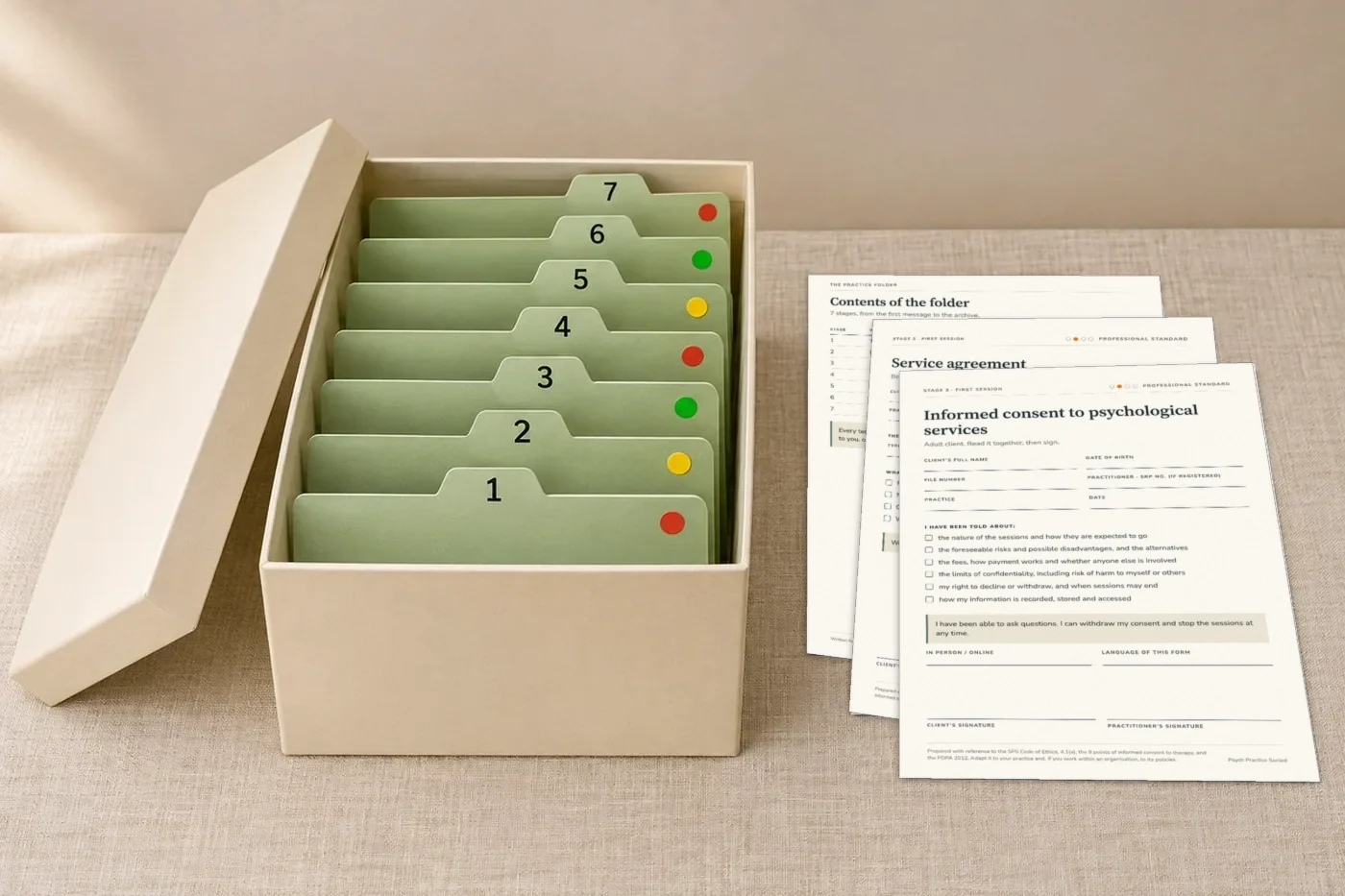
A consent form copied from a colleague was written for their practice, not yours. Here your documents come in the order you use them with each client, from the first message to the archive.
Written for private practice in Singapore, with reference to the Personal Data Protection Act 2012 (PDPA) and the Singapore Psychological Society’s Code of Ethics. Each template states its reference at the foot of the page: the law, the professional standard or good practice. Mandatory registration of psychologists is on its way (MOH): your paperwork can be ready first.
Every template in Psych Practice Sorted carries a coloured dot that tells you what it rests on. Answer the 7 questions, one for each stage of the folder.
Required: the PDPAProfessional standard (SPS Code)If it applies to youProtects you
01
The practiceAre your fees and your cancellation policy written down, and do clients agree to them before the first session?
02
First contactDoes every client get a privacy notice when you first collect their details, and is your data protection officer’s contact published?
03
First sessionFor every client, is there a signed consent form covering the 9 points, and a service agreement you could show?
04
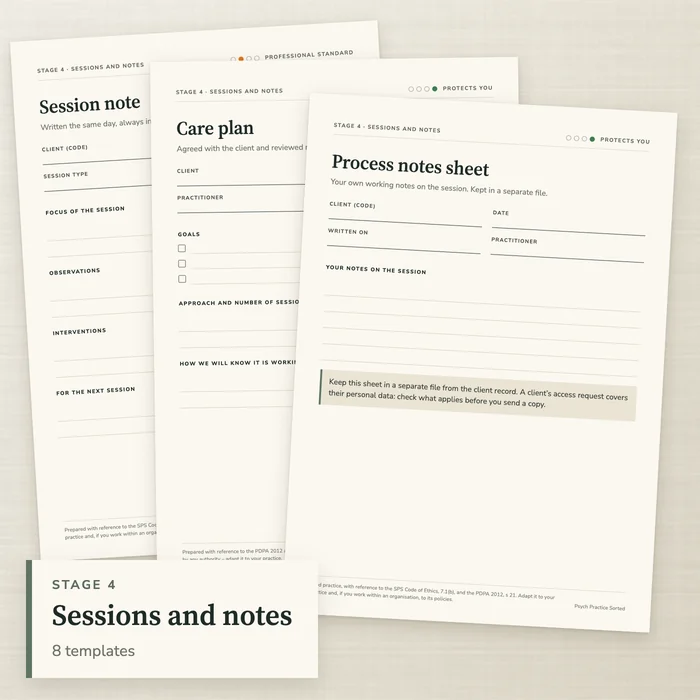
SessionsDo you write every session note on the same template, and keep your own process notes in a separate file?
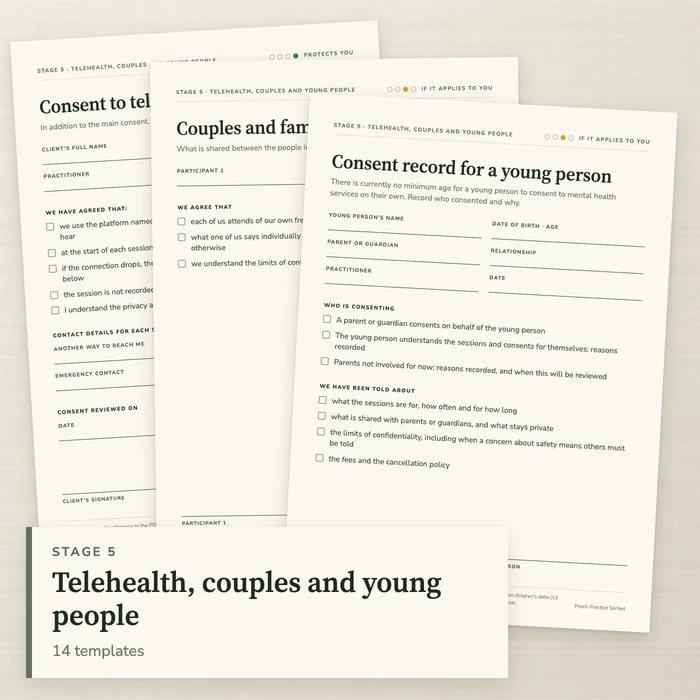
Telehealth, couples, young peopleDo you have separate consent forms for online sessions, couples and young people, with a record of who consented and why?
06
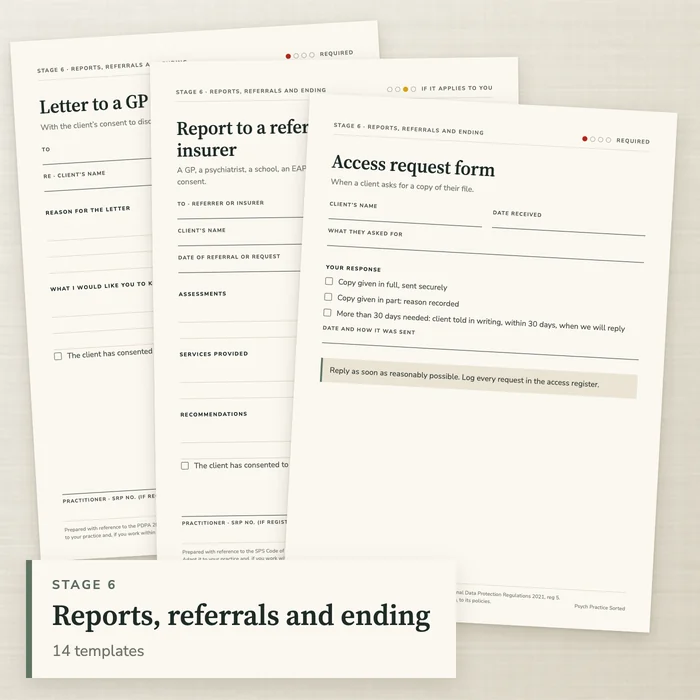
Reports and referralsDo your reports and letters always carry your details, the recipient and the subject, with the client’s consent on file?
07
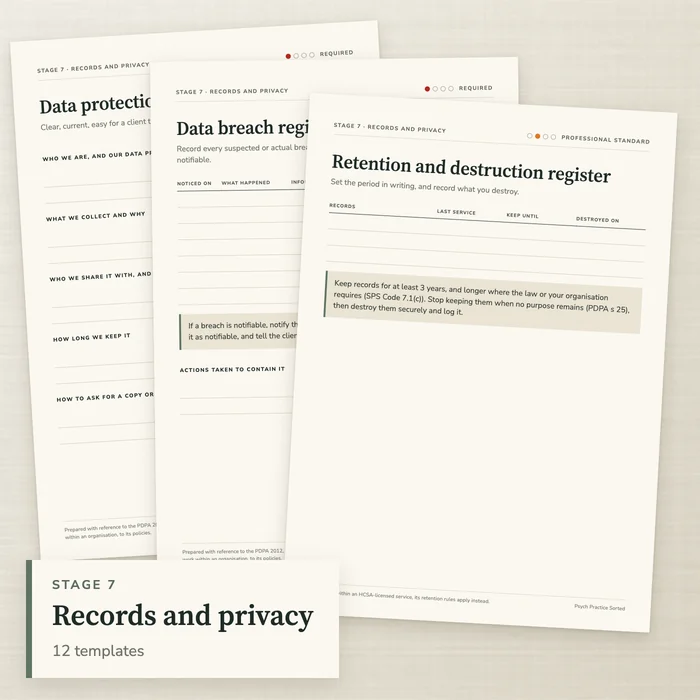
Records and privacyDo you have a data protection policy, a breach plan that reaches the PDPC within 3 calendar days, and a retention register?
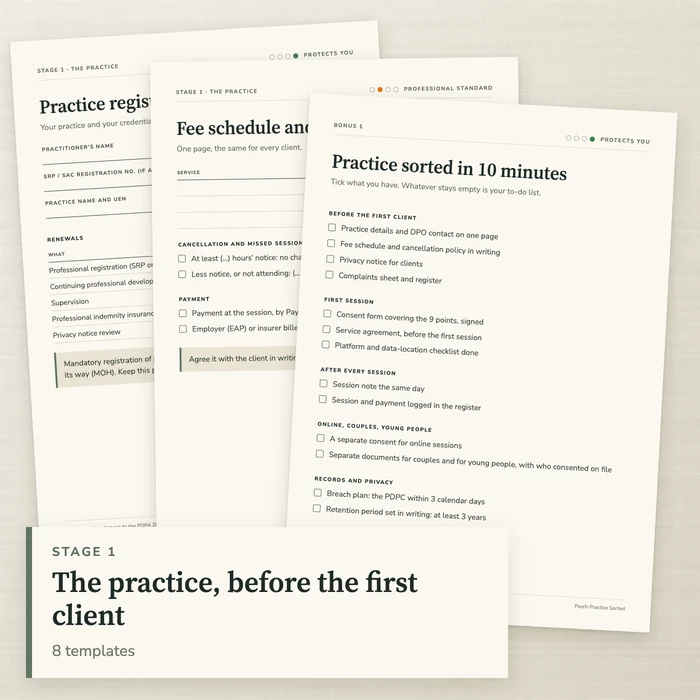
The practice, before the first client · 8 templates
Solves“I’m not sure what I should have ready before the first client.”
Practice register: your qualifications, SRP or SAC registration if you have one, renewals, continuing professional development, supervision and professional indemnity insurance; plus a letterhead and practice details sheet, with your UEN and your data protection officer (the PDPA asks you to designate one and publish their business contact)
Fee schedule and cancellation policy, agreed with the client in writing at the stage of informed consent (SPS Code of Ethics, 7.2(a))
Complaints sheet and register, and a platform and data-location checklist: where are the servers, who can see the files, is there a backup? (Under the PDPA, data sent outside Singapore needs comparable protection.)
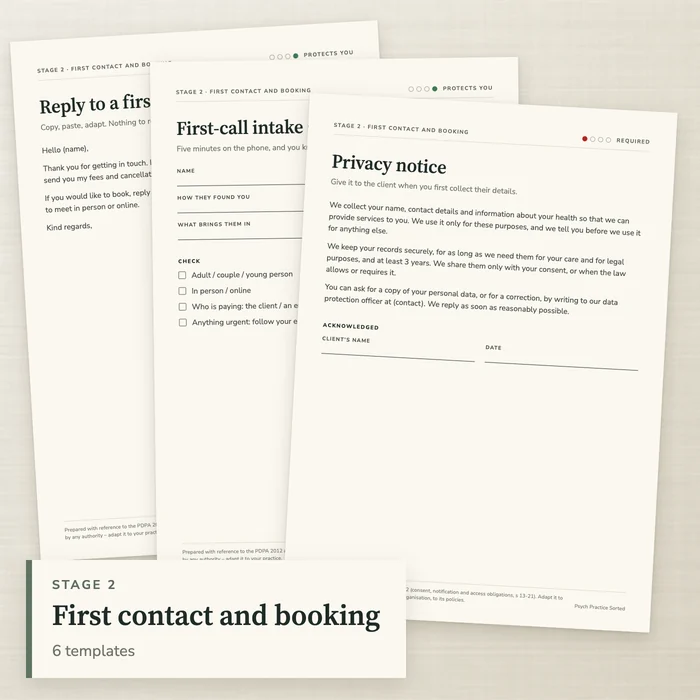
Solves“Every new enquiry, I write the reply from scratch.”
Reply to a first enquiry, first-call intake sheet, appointment confirmation and reminder
Who-is-paying checklist: the client, an employer (EAP) or an insurer, and who referred the client (cover depends on each policy: the folder doesn’t say what anyone will pay)
Privacy notice to give when you first collect a client’s details (PDPA consent and notification obligations), and consent to contact by message or email
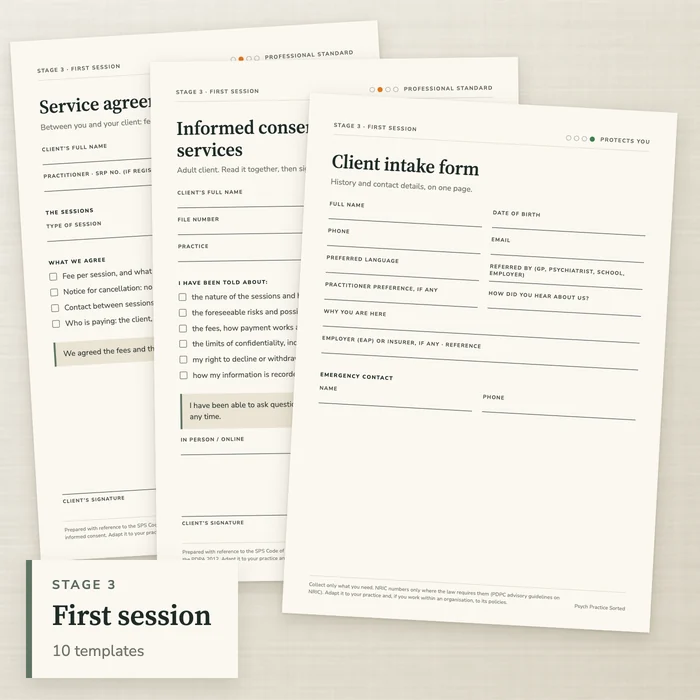
Solves“I improvise the consent in front of the client.”
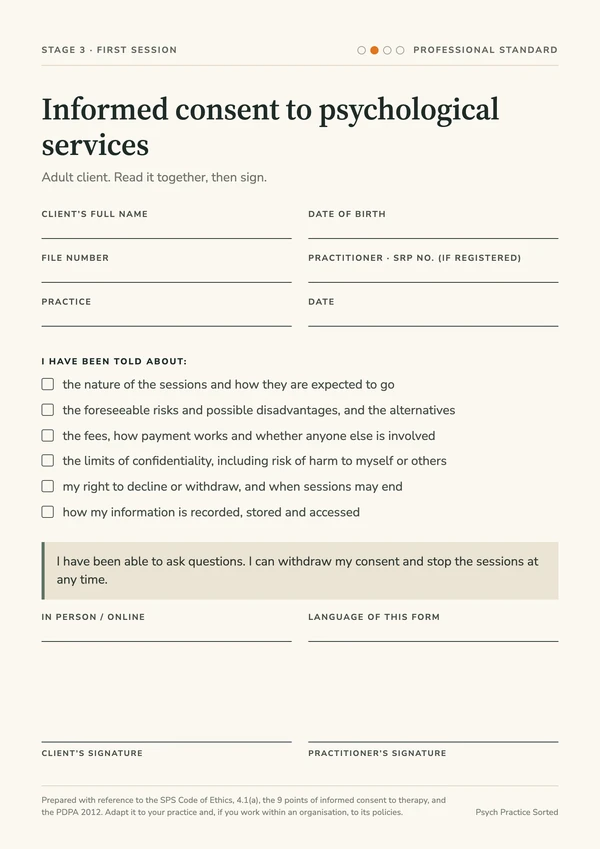
Informed consent to psychological services, built on the 9 points of the SPS Code of Ethics (4.1(a)): the nature and course of therapy, the risks, the right to decline or withdraw, how information is recorded and stored, the fees, third parties, the limits of confidentiality and when therapy may end
Intake form that collects only what you need (no NRIC unless the law requires it), with language, practitioner preference and an emergency contact; assessment consent and a service agreement
The limits of confidentiality in plain words (risk of harm to self or others, a child at risk, vulnerable adults, court orders), consent to record a session, AI note-taker consent and opt-out, and consent to share information with the client’s GP or psychiatrist
Telehealth, couples and young people · 14 templates
Solves“I have the same form for an adult, a couple, a teenager and online sessions.”
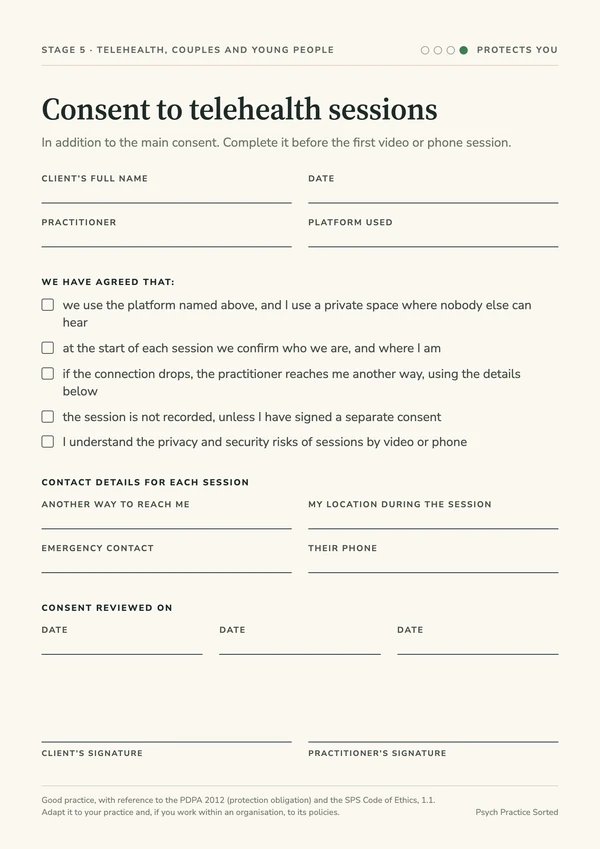
Telehealth: consent and session safety plan (platform, private space, another way to reach the client if the connection drops, location and emergency contact)
Couples and family agreement: what is shared between the people in the room
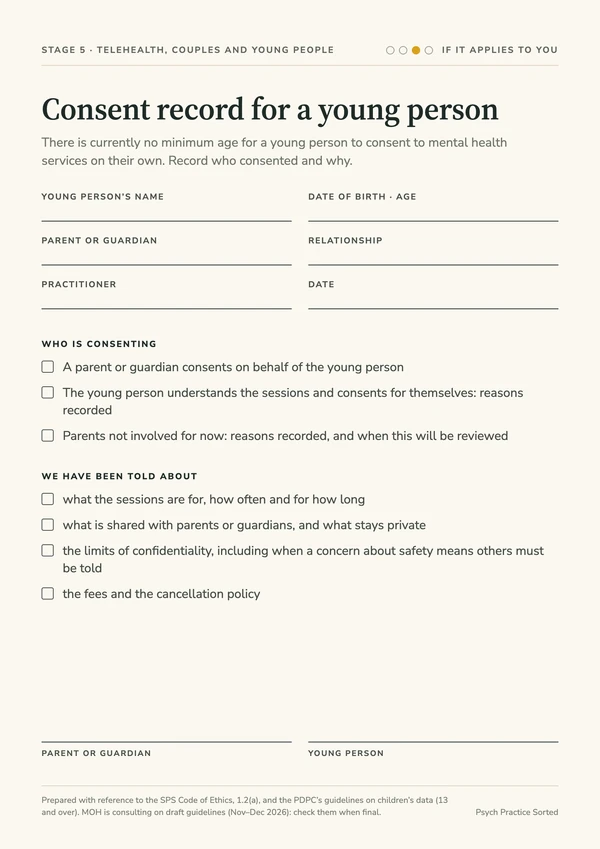
Young people: parent or guardian consent, the young person’s own consent with your reasons recorded, a record for when parents are not involved and when you will review it, and a child-protection referral record. There is currently no minimum age for a young person to consent to mental health services on their own, and MOH is consulting on draft guidelines: the forms record who consented and why
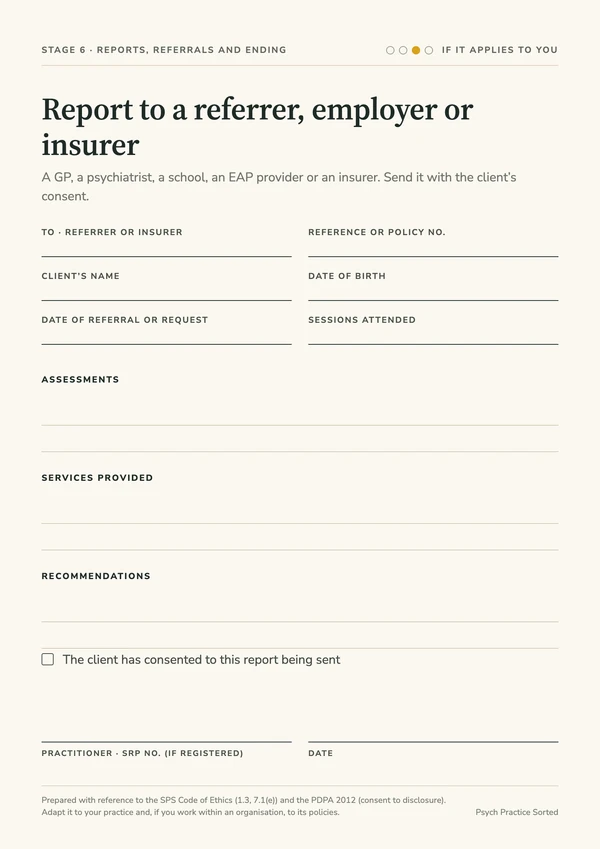
Report and letter header with your details, recipient and subject; consent to disclose information, referral letter and letter to a GP or psychiatrist
Itemised receipt for employer, EAP or insurer claims, a report template for schools and employers, and an attendance letter. If an EAP provider or insurer has its own forms, follow theirs first
Access request form, access register and your reply letter (under the PDPA you reply as soon as reasonably possible, and if you need more than 30 days you tell the client in writing within those 30 days), discharge summary, termination letter, practice closure letter and a custodian-of-records plan
Solves“I’m not sure my clients’ information is handled properly.”
Data protection policy that says who your data protection officer is, what you collect, who you share it with and how a client asks for a copy or a correction (PDPA 2012)
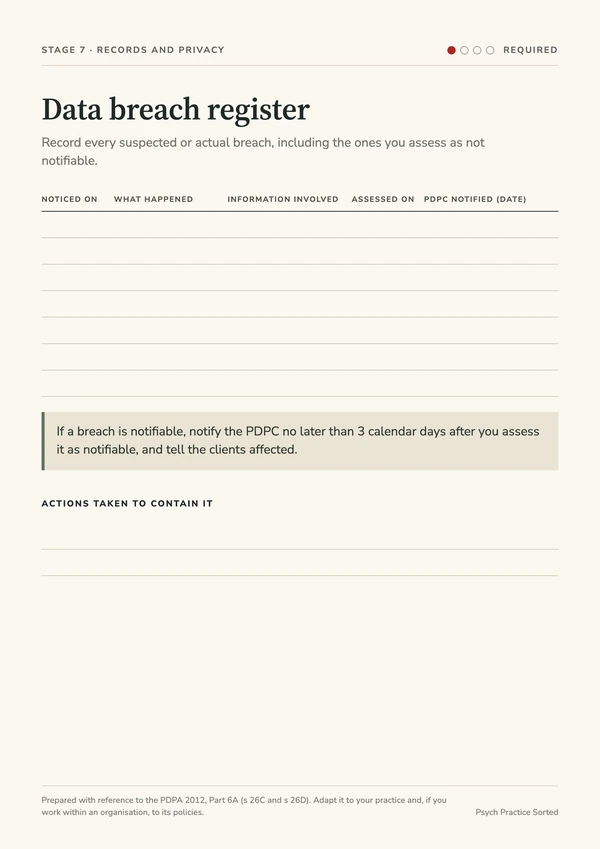
Data breach plan and register: assess quickly and, if the breach is notifiable, notify the PDPC within 3 calendar days (PDPA Part 6A); disclosure log (reason, what, to whom) and a security checklist for your software, cloud and telehealth platforms
Retention and destruction register: keep records for at least 3 years, and longer where the law or your organisation requires (SPS Code of Ethics, 7.1(c)), and a continuity-of-care plan
30-day money-back guaranteeIf the folder isn’t right for your practice, email us within 30 days of purchase and we’ll refund you in full. These are editable templates in English that you adapt to your own practice. They are not legal or clinical advice and do not replace professional standards, your organisation’s policies, your supervisor or a lawyer.
Fast deliveryStraight after payment you receive the welcome guide with the checklist by email. The 72 templates, the 7 dividers and the 5 bonuses arrive at the same address within 48 hours.
Secure payment
One-off payment
30-day guarantee
By email
★★★★★ 4.9 out of 5
What colleagues who use it already say
Practitioners across Singapore who sorted their paperwork.
★★★★★Mei Ling T. · psychologist in private practice · Novena
“I’d been using the consent form from my training placement for years. Now I have one for adults, one for couples and one for teenagers, and every one covers the nine points. I put my details on everything in one afternoon.”
“I see clients online and in person, and my consent form was written for the consulting room. The telehealth consent and the safety plan for a dropped connection were ready to adapt, so I didn’t start from a blank page.”
★★★★★Nurul H. · counsellor · Tampines
“My cancellation policy lived in WhatsApp messages. Now it is one page the client signs with the consent form, and nobody argues about a late cancellation any more.”
★★★★★Daniel K. · psychotherapist, new to private practice · Toa Payoh
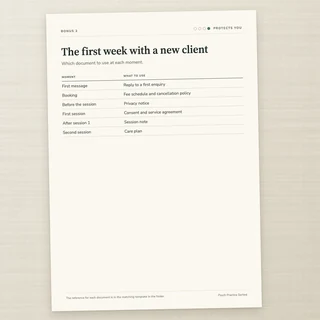
“I’d just started out and didn’t know what to use when. The bonus ‘The first week with a new client’ showed me which document to send at the first message, in the first session and after it. For S$24.90 I didn’t expect this much.”
★★★★★Siti A. · works with young people · Jurong East
“With teenagers I never knew what to write down when a parent wasn’t involved. Now I have the consent record with my reasons and a date to review it. Nothing to look for.”
★★★★★Rachel L. · psychologist · Holland Village
“When a client asked for a copy of their file, I had the request form, the register and the reply letter, and my process notes were already in a separate file. It was sorted without losing my evening.”
★★★★★Wei Jie C. · counsellor · Bishan
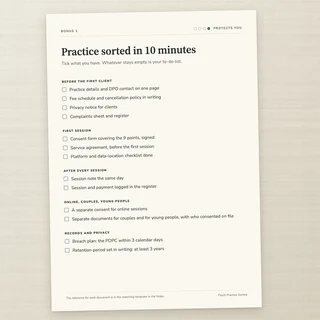
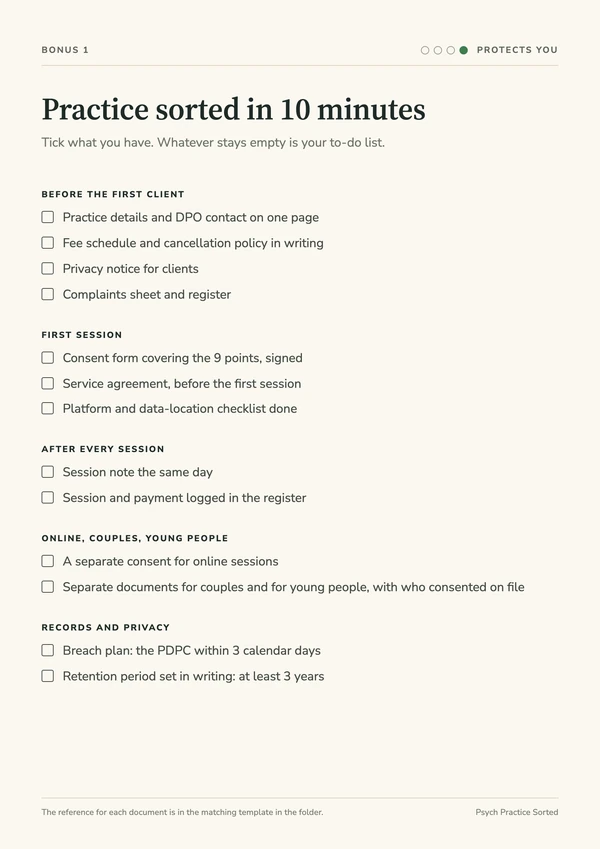
“The checklist showed me in ten minutes that I had no breach plan and no data protection officer named anywhere. A week later both were done, in one folder.”
you only work in a hospital, clinic or organisation that has its own forms and policies;
you’re looking for clinical protocols or worksheets for your clients: these are the documents of the practice;
you want practice-management software: this is a folder of documents, not an app.
Straight after payment you receive the welcome guide by email, with your order details and the checklist ‘Practice sorted in 10 minutes’. The 72 templates, the 7 dividers and the 5 bonuses arrive at the same address within 48 hours, in Word and PDF. If you can’t see the email, check your spam and promotions folders too.
Yes. They are ready-to-edit templates written for psychologists, counsellors and psychotherapists in private practice in Singapore, prepared with reference to the framework as at November 2026: the Personal Data Protection Act 2012 and its regulations, the PDPC’s advisory guidelines and the Singapore Psychological Society’s Code of Ethics. Each template states its reference at the foot of the page, and says whether it is law, a professional standard or good practice. These are editable templates in English that you adapt to your own practice. They are not legal or clinical advice. Psych Practice Sorted is an independent publisher. It is not affiliated with, approved or endorsed by the Ministry of Health, the Allied Health Professions Council, the Singapore Psychological Society, the Singapore Association for Counselling, the PDPC or any other authority or professional body.
Today registration is voluntary, through the Singapore Register of Psychologists. MOH has said psychologists in five subdisciplines will be registered under the Allied Health Professions Act, with protected titles, a public register and a code of professional conduct. The folder doesn’t register you and doesn’t say what the new rules will require: it gets your everyday paperwork in order now, and the updates bonus sends you new versions when the rules behind a template change.
The SPS Code of Ethics asks you to obtain informed consent at the earliest possible time, in a language the client understands, and lists 9 points it should cover, including fees and the limits of confidentiality. A signed form is the simplest way to show what the client was told. The folder gives you a consent form on those 9 points, a separate consent for online sessions and a service agreement.
Yes. The PDPA applies to any organisation that collects personal data, including a one-person practice. Where a template cites the SPS Code of Ethics, check it against your own professional body’s code (for example, the Singapore Association for Counselling).
The folder is for your own practice. If you work within an organisation, or within a service licensed under the Healthcare Services Act, its own forms and policies come first. If you work under a supervisor, check each document with them before you use it.
Yes. The bonus ‘The first week with a new client’ shows you which document to use at each moment, and the checklist what to have ready before your first client. The letterhead has fields for your practice details and your data protection officer.
MOH has said there is currently no minimum age for a young person to consent to mental health services on their own, and it is consulting on draft guidelines until 8 December 2026. For personal data, the PDPC’s guidelines say a young person aged 13 or over can usually consent if they understand what they are agreeing to. The folder gives you a parent or guardian consent, a record of the young person’s own consent with your reasons, and a record for when parents are not involved and when you will review it. It doesn’t decide for you: it records what you decided and why.
The folder has a who-is-paying checklist, an itemised receipt, a report template and an attendance letter. Whether a policy or an EAP covers psychology sessions, and on what conditions, depends on them: the folder doesn’t say what anyone will pay. If an EAP provider or insurer has its own forms, follow theirs first, and send a report only with the client’s consent.
The folder has a service agreement and a fee schedule with a cancellation policy that the client reads before consenting. The SPS Code of Ethics asks for billing and payment arrangements to be agreed at the stage of informed consent. Whether and how much you charge for a missed session is your decision: write it down once, and the client signs it with the consent form.
Yes. Each has its own document, and the dot at the top tells you what it rests on. The telehealth consent covers the platform, privacy and security, another way to reach the client if the connection drops, the client’s location and an emergency contact. There is also an AI note-taker consent and opt-out.
Under the PDPA you assess a breach quickly and, if it is notifiable (significant harm, or 500 people or more), you notify the PDPC no later than 3 calendar days after that assessment, and tell the clients affected. The folder has a breach plan with those steps and a register for every breach, including the ones you assess as not notifiable.
The SPS Code of Ethics says at least 3 years, and longer where the law or your organisation requires. Under the PDPA you stop keeping personal data once no legal or business purpose remains. If you work within a service licensed under the Healthcare Services Act, its retention rules apply. The retention and destruction register does the counting.
Word (it also opens in Google Docs and Pages) and print-ready PDF. No software to learn.
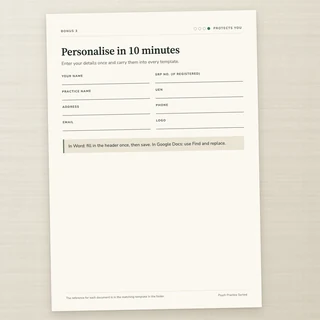
Yes. You enter your name, registration, practice details and logo once and carry them into every template. The bonus ‘Personalise in 10 minutes’ shows you how.
10 minutes for the checklist. Then 15 minutes a day for 7 days, one stage at a time.
A copied consent form was written for someone else’s practice, and often for another country. Here you have the documents in the order you use them with a client, sorted by situation, with your letterhead and a dot that shows you what each one rests on.
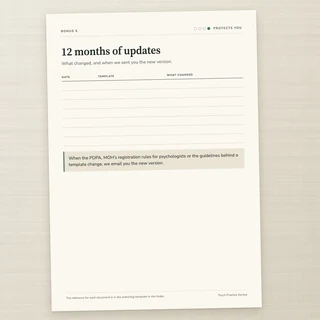
Registration of psychologists and MOH’s guidelines for young people are both on the way. If within 12 months of purchase the PDPA, MOH’s registration rules or the guidelines behind a template change, we email you the new version.
No. You pay S$24.90 once, and the documents are yours, with updates for 12 months.
You have 30 days: one email to thehoord@gmail.com is enough and we refund you in full. The templates stay yours.
Privacy. The entity responsible for your personal information is The Foorge (NRT F-421429-V), Carrer de l’Estadi 18, 1-1, AD500 Andorra la Vella, Andorra, thehoord@gmail.com, who also acts as our data protection contact. We handle your name, email address and order details to deliver your order, meet our accounting obligations and keep the shop secure, in line with Singapore’s Personal Data Protection Act 2012. We share them with Impultienda, Stripe, PayPal, Moonshot Marketing Agency LLC, our hosting and email providers and Meta Platforms (ad measurement); some of them are outside Singapore and protect your data to a comparable standard. During your visit the page loads the Meta pixel (cookie _fbp) to measure our ads; you can block cookies in your browser. We do not store card details, and we do not ask for any information about your clients. You can ask for access to your information or its correction by emailing thehoord@gmail.com: we reply as soon as reasonably possible, and within 30 days. If you are not satisfied with our response, you can complain to the Personal Data Protection Commission.
Terms. Digital product, one-off payment of S$24.90, no subscription. The welcome guide is emailed straight after payment; the 72 templates, the 7 dividers and the 5 bonuses within 48 hours. The templates are in English. These are editable templates that you adapt to your own practice. They are not legal or clinical advice and do not replace professional standards, your organisation’s policies, your supervisor or a lawyer. Updates included for 12 months from purchase. Sold by Moonshot Marketing Agency LLC, trading as The Hoord.
Refunds. 30-day money-back guarantee: if the folder isn’t right for your practice, email thehoord@gmail.com from the address you used to order, within 30 days of purchase, and we’ll refund you in full. If the folder hasn’t reached you, email us and we resend it or, if you prefer, refund you.